
How to Detect & Check for a Leak
A leak as small as a pinhole can waste hundreds of gallons of water a day. Your water meter is sensitive enough to detect even the slightest flow. Follow these steps to see if water is moving through your pipes when it shouldn't be.
Step 1: The Total Blackout
Before checking the meter, ensure all water usage inside and outside the home is stopped.
- Turn off all faucets and showers.
- Ensure the dishwasher and washing machine are not running.
- Turn off ice makers and automatic irrigation systems.
Step 2: Check Your Specific Meter Type
Locate your meter (usually in a basement) and check the display:
For the T-10 (Mechanical Meter)
Look for the Leak Indicator, which is a small red star-shaped wheel or triangle on the face of the register.
- The Test: Watch that small red dial for at least 2 minutes.
- The Result: If that dial is spinning--even very slowly--water is passing through the meter. Since you turned everything off, this confirms a leak.
For the MACH 10 (Digital/Ultrasound)
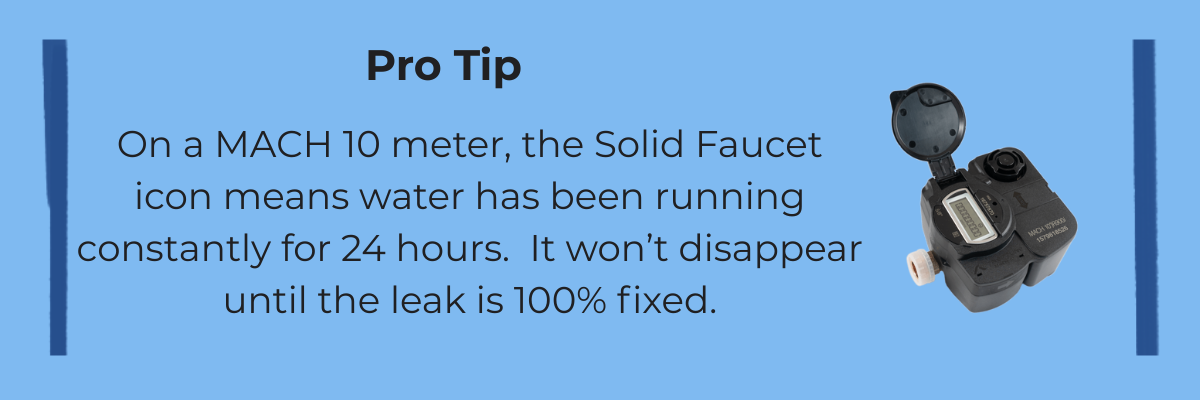
The MACH 10 uses a high-solution LCD. It doesn't have a spinning wheel, but it has a specific Leak Icon.
- The Test: Look at the LCD screen. You are looking for a faucet icon in the corner of the display.
- The Result: *Flashing Faucet: Indicates an intermittent leak (water has run constantly for the last 24 hours).
- Solid Faucet: Indicates a continuous leak (water has run constantly for for the last 24 hours).
- Flow Rate: Check the numbers on the screen. If you see a decimal flow (e.g., 0.01 GPM) while your water is off, a leak is present.
Step 3: Isolate the Leak
If the meter shows water is running, you can narrow it down:
- Check the Toilets: This the is most common culprit. Put a few drops of food colouring in the tank. If colour appears in the bowl after 15 minutes (without flushing), you've found your leak.
- Main Shut-off Test: Turn off the main water valve inside your house. If the meter stops moving, the leak is inside. If the meter continues to move, the leak is in the service line between the meter and your house.